
The Marks of Our Time
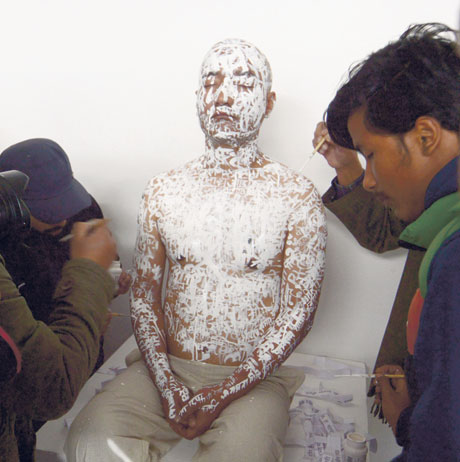
January 27 saw the unfolding of an intriguing art event at the Siddhartha Art Gallery (SAG) in Baber Mahal Revisited, Kathmandu.
Artist Sujan Chitrakar, who heads the Painting and Design Department at Kathmandu University, presented himself to an open group of participants/viewers as he underwent a performance orchestrated by himself and Pranab Man Singh.
The event started on schedule at 2 PM and right after a few preliminary remarks (including those by SAG curator Sangeeta Thapa), Sujan sat himself down and allowed a local barber to shave off all his hair as well as his signature moustache and beard. Enmeshed in his own inner silence, the artist sat stoically as lock after lock fell to the floor.
The artist seemed to be shedding not only bits and pieces of his personal physical markers but also pieces of his own socio-cultural identity. And gradually assumed the role of a catalyst—igniting public opinion through the performative act of subjecting himself to the razor. It was a moment of personal loss and remembrance—the artist was simultaneously mourning the loss of his grandfather Chiniya Chitrakar 40 years ago on this very date. A moment of remembrance and tribute to a pioneer who had consciously veered the course of the Chitrakar community’s role in society from the ritualistic to a more commercial, and therefore, ‘modern’ art. The act, however, took on an element of public lament. No words were spoken but soon it was obvious that the artist was also taking onto his flesh the burden of a state that has yet again failed to deliver a Constitution to its people. A ritual act of remembrance soon took on an explosive element of resistance. Afterwards, as Sujan took off his clothing and sat himself before us on an elevated white platform in just a pair of white linen trousers and socks, he himself became a canvas. Against a white background, his unclothed torso and newly shaven head became the space in which the second half of the ceremony unfolded .
Neatly folded, tiny slips of paper awaited us in a glass fishbowl at one corner. We, random participants and viewers, were invited to pick one each and read out the name inscribed upon it as we proceeded to write the same on Sujan’s body. In white paint. As each willing, random participant read out the text in each slip, it was obvious that we were beginning to enumerate the current Constituent Assembly’s lineup. Sujan had receded from his person and identity and allowed his body to take on the nation’s mantle—and its political debacle. Students, artists, aficionados, spectators crowded in as the implications sunk in. They hurried, scurried, jostled to pick up a slip each and inscribe upon him a name, calling out the perpetrator’s name each time, and loudly. What started as an intense act of personal mourning transformed itself into an hour-long calling out to those who have failed us again, and again. The anger and fury and helplessness that we all feel today in Nepal was vented out in white inscriptions on the artist’s body. By the end of the two hours, the artist sat silent, immersed in his act of public, ritualistic atonement. The fishbowl is significant; we have all seen those goldfish go round and round and nowhere—the metaphor for our CA is unavoidable. As Sujan’s last act – when he rinsed his face off with clear water and walked away – a silent act of penance that ignited many fervent, committed souls that afternoon.
The artist has deleted his identity, taking on the nation’s—its helplessness and fury—and given us the possibility of new beginnings yet to come.
It is not often that we see an artwork evolve into a live outpouring of public emotions and turning into a simultaneous political comment.
Kurchi Das Gupta
