
Eccentric expressions
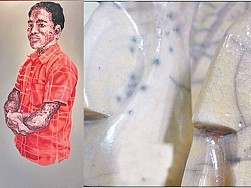
As you enter the Siddhartha Art Gallery at Baber Mahal Revisited, you are greeted by the bright gallery lights, a somewhat not appropriate, yet icebreaking radio pounding Nepali rhythms and the familiarity of an empty art gallery. Yes, familiarity, since art galleries seem to be rarely frequented in Nepal. But maybe it is better this way—art lovers are at their leisure as they glance, admire, and wonder of the meaning behind each piece in calm solitude. In this particular exhibition, somewhat deformed yet beautiful figures glance back at you from large canvases. Thick lips, small eyes, short necks, jet black hair and large ears are the common features of the friendly portraits of ordinary Nepali people.
The extravagant portraits are part of the Pl. series by Man Bahadur Harijan, mostly depicting men and a few women, some wearing modern clothes—t-shirts stamped with brands like All Star and Converse—and others in traditional clothing. Harijan creates sequences on canvas emphasising on the movement and positioning of the bodies as well as highlighting with pride the darker skin tones of Nepali people. The emphasis is created through extremely plain, untouched backgrounds and a strong contrast between the actual human figure and the clothes worn. Doing so allows the bodies to stick out of the canvas with an admirable dabbing technique. The smell of fresh paint still appears to linger in the air making one wonder whether the paint might still be wet as well, remarkably shiny as it appears from up close.
As you go up to the first floor, the exhibition changes, and you discover corners filled with innovation—small and big installations of ceramic pieces that are part of Ceramic Hands’ Expressions in Clay. Two pieces in particular make you stop and stare. Number 08, Fallen Impression, by Swosti Rajbhandari, comprises of seven ceramic leaves—of different shapes and colours—hanging in mid-air against a dangerously white wall. Rajbhandari says working with ceramics “immerses you deep into its flexibility, its various forms, and its textures.” The petite installation doesn’t tell you anything at first glance. However, keep on staring and a million thoughts will soon emerge; thoughts, that like the ceramic leaves, will hang in a little corner of your brain.
Number 24 too strikes as something very unusual, particularly given the conventions of Nepali art. Rabindra Kumar Shrestha has placed 10 rectangular ceramic pieces against one long black background to create ad aesthetic piece of great depth in meaning. “Every single element that the universe constitutes of has a defined line, when a line is broken down into simpler and minimal forms, it scatters into several lines, to the point where these lines are not even visible. These lines are however evident and can certainly be felt,” he says by way of explanation. In The Line, Soul of the Universe, the marble pieces are all identical, contrasted with a thick, red line which joins them; flowing through them—both solid and invisible at some points. Surrounding this main line are also minute lines with no pattern or direction whatsoever flooding the white marble.
Going up the wooden steps to the 2nd floor, you find yourself in a completely white room. You might think you’ve gone crazy but this is, in fact, part of Expressions in Clay. Expressive and soulful masks abound. Behind every mask is placed a carpet with loose strings hanging low and sweeping the floor. Suspended from the ceiling are figurines hanging in the most bizarre postures, and it is easy to lose oneself staring at these.
The two exhibitions combined create an eccentric trip on a visual level and promise to create commotion and a voice for both Harijan’s paintings and the experimentations with a relatively new media such as ceramics. Gopal Kalapremi Shrestha, one of the few clay artists in Nepal who is also participating in the exhibition says Expressions in Clay aims to “encourage the development of ceramic art in Nepal,” a scrupulous process that other countries have already gone through. “Since Nepal is already renowned for its handicrafts, it should in fact, have the opportunity to experiment with such new media,” he adds.
The two exhibitions will continue at the Siddartha Art Gallery till July 23.
Gallery hours are 11am-6pm daily.
