
A Place Called Home
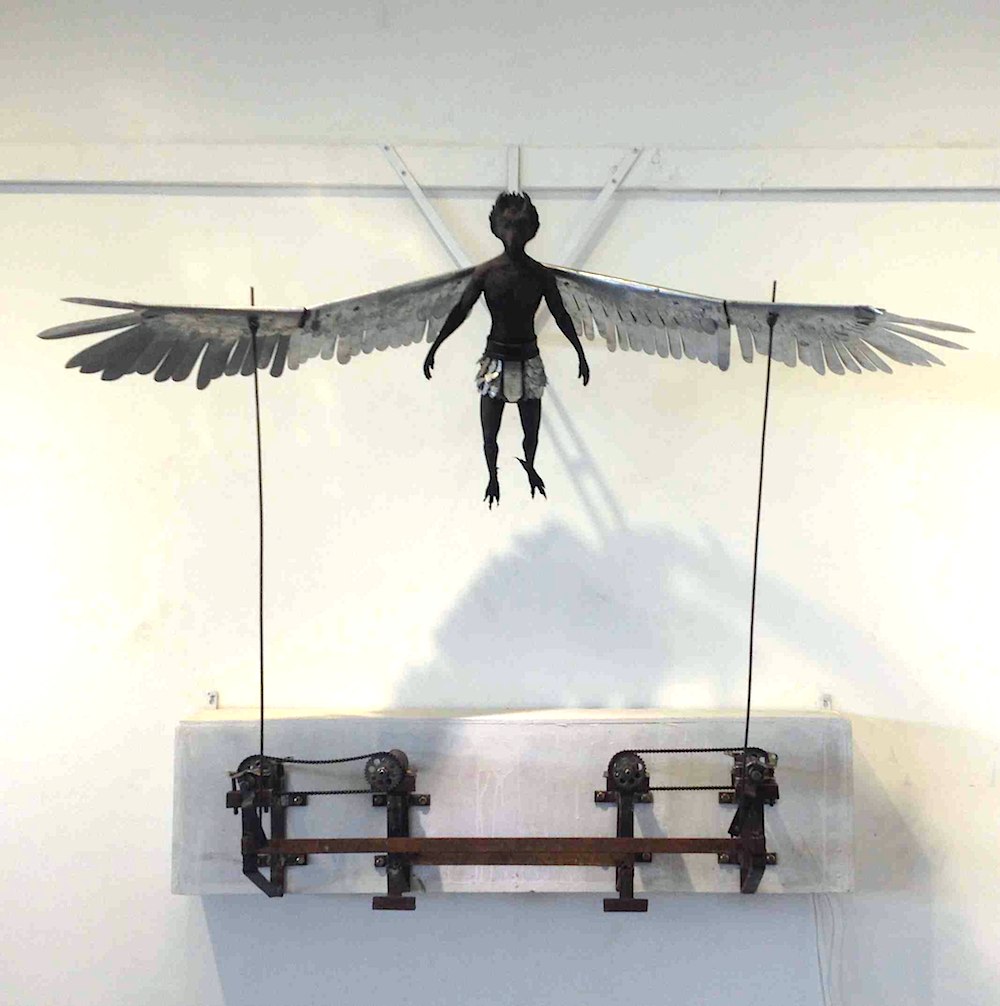
Blink and you’ll miss it – KU Art+Design’s week-long exhibition at the Nepal Art Council in Babar Mahal is the creative explosion of a generation of graduates from Kathmandu University’s Bachelor of Fine Arts, and unless you’re one of those hapless fools tasked to “draft” our constitution down the road, I’d recommend getting there by Wednesday, when the show closes. BFA Exhibition Project 2014 signifies unfettered creativity as much as the discipline required to complete a four-year degree and six months of intensive studio work – the installations, even the most straightforward of which deviate from what Nepali audiences might traditionally define as “Art”, are a collective revelation.
In a related sense, Anish Bajracharya and Tsewang Lama play with reinterpretations of that which is familiar to Nepalis. Bajracharya’s refashioning of the iconic Goldstar, the “shoe of the masses”, is simply inspired. Or as he puts it in the tagline for his imaginary brand (albeit fronted with real shoes that I was tempted to try on), “inspired by the land”. If Goldstar dares to come out with a shoe that incorporates within its design Nepal’s plains, hills, water bodies and mountains, it would be, if you’ll excuse the pun, “revolutionary”. Lama’s critique of urbanization, meanwhile, could be viewed as one more in a long line of anguished responses to Kathmandu’s apparently inexorable decline. But his representations of the chaos of the capital churn inside of the viewer’s mind. The style recalls the clichéd touristic vistas of Nepal’s mountains, temples and alleys; the content, conflagrations of cars and concrete, quite literally demolishes that becalming notion.
I remember the excitement I felt when I encountered US-based artist Binod Shrestha’s installation, Rhythm of Solitude, at the Yala Maya Kendra in Patan. Back in 2009, it seemed to me that installation art was a relatively new chapter for Nepali contemporary art. BFA Exhibition Project 2014 proves that explorations in this genre are far advanced. The young Nepali artists on show at the Nepal Art Council until 6 August are poised, like the aforementioned mechanical Garuda, to launch into their self-defined, disparate orbits before too long – this is a rare opportunity to catch them all in the flesh and ask them about the worlds they envision, before they have quite created them.
Living as they do in a country struggling to reconcile past and present, it is no surprise that much of the work on display grapples with themes of environmental degradation and socio-political boundaries. Many of the artists draw on the familiar to refresh our understanding of a culture besieged by modernity. Kiran Rai’s startling mechanical prostheses for mythical creatures, such as a pair of shiny metal wings for a garud that flaps about with unwieldy grace at the flick of a switch, shatter our perceptions of myth as something frozen in time. The notion of beauty itself is challenged by Prajwal Bhattarai, whose “re-cycles” reveal a deep understanding of how (discarded) objects can be repurposed to recall wholly different arenas of aesthetic endeavour.
